One of the biggest worries for new tattoo artists is probably the question of how far you have to put the needle into the skin. And it is an important factor to consider if you want the tattoo to stay in place and last for a lifetime.
With this post i would like to end a lot of that confusion and share with you a neat trick to make sure you get the right depth every time.
First off all there are three important layers of the skin you should concern yourself with: The epidermis, the dermis and the hypodermis. And depending on what layer you inject the ink in it will stay in place or not.
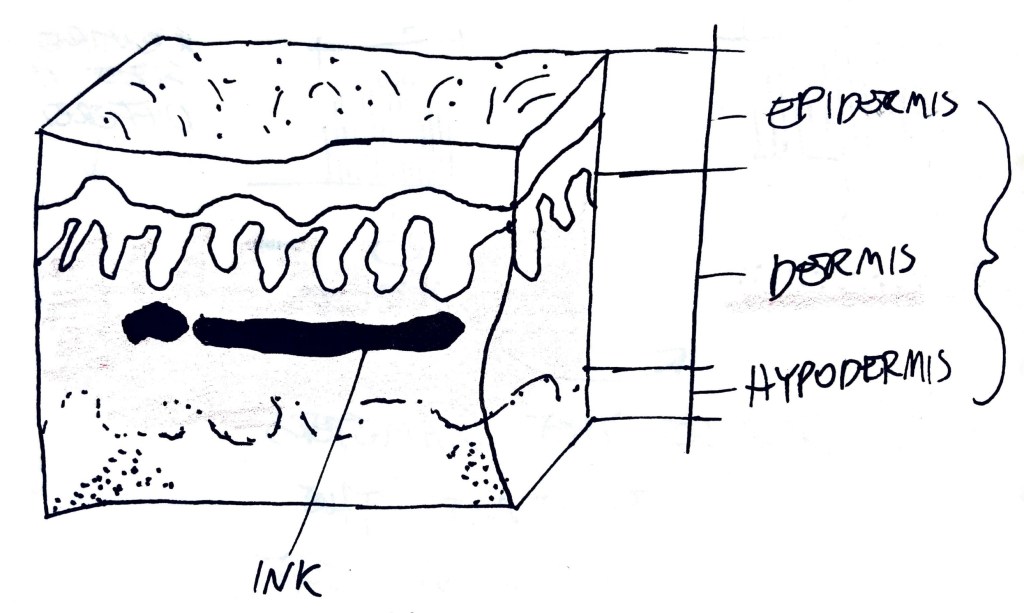
The epidermis is the top outer layer of the skin, the comes the dermis and then the hypodermis. As seen on the diagram the dermis is the correct layer and this is where the ink will stay in place and not move. This is the layer you must aim for if you want your tattoo to last.
If you would inject the ink into the Epidermis layer (or not going in far enough) the ink will just fade out and the body would reject it. This is because of the body’s natural healing process – the outer layer renews itself every four to six weeks.
Going into the Hypodermis layer (or too deep), the ink wouldn’t stay in the same place or bleed out under the skin. This is a natural defence mechanism: It carries the ink away and you could really risk some bad scaring if you are not careful.
So just take your time and be aware of that. You have to know that every person’s skin is different. Also depending on the area of skin you are tattooing it will differentiate a great deal – The skin on an ellbow is a lot thinner than on the thighs for example. And the skin of older individuals is thinner than the skin of a young person.
The first few minutes of tattooing is getting used to your client’s skin – How deep to go, how it feels, how it reacts to the needls. All tattoo needles do is use friction and gravity to push ink into the skin, but you are the brains of the operation.
How to find the correct needle depth:
Artists who have been tattooing for a while might have a sense for it and would feel the difference of vibration on there stretching hand (also stretching is important to maintain a consistent depth) or on the machine sound output. But for a beginner you have to rely on your eyes:
1.) Have the needle hanging out of the tip far enought so that you can clearly see it. I usually have it hanging out about 2 mm, but that is personal prefference. Also I wouldn’t “ride the tube”.
2.) Now just touch the skin very lightely with the tip of the needle, so you can just see the dots the needle make. Then without lifting the needle up go in slightly further and make a small line.
3.) After that, wipe it carefully and check the line you just tattooed – If it isn’t a clear line, but a light faded out looking line, you haven’t gone deep enough, and you put the ink just into the epidermis layer of the skin.
4.) Being aware of how far you went into the first time, go in again into the same line, but go in a little bit deeper. If the line is solid, you just found out the correct needle depth for that customers skin. If not, go in again but a bitBeing deeper next time. You don’t have to go far into the skin at all to make a solid line as you can see.
…So I hope that helped some people out there. It is not rocket science and you get the hang of it pretty quickly with just some practice. I would also like to hear your opinions on this, so please put them into the comments.
-Chrisi
 Welcome to the Abyss
Leave a comment